
Lafayette County Wanted List Status
The Lafayette County Sheriff's Office does not maintain a public most-wanted page. There is no gallery of faces, no count of listed people, no update schedule, and no archive of past appeals. No county Crime Stoppers reward program appears on the agency site, and no recurring feature such as a weekly warrant roundup exists either. Even a selective public appeal would fall short of a complete roster of active warrants.
Local official material is thinner than most people expect. The LCSO Civil Process & Warrants page describes a division that serves judicial process and enforces court orders, yet it offers no name-search box anywhere. The sheriff's FAQ sends warrant questions to the statewide Florida Crime Information Center instead. That is the correct Lafayette County route. Skip stale search results, social media photos, commercial mugshot sites, and look-alike jurisdictions that share the county's name.
Note: The sheriff publishes no wanted list, so any face or name on a third-party site is not an official Lafayette County record.
Lafayette Wanted Fields Not Published
A typical wanted-list field guide does not work here. Guessing at columns LCSO might display would suggest information the agency never actually publishes. What can be said with confidence is simple. No official county list exists. Each question belongs with the office or database that handles it.
| Possible listing field | Lafayette County finding |
|---|---|
| Name and photograph | No LCSO most-wanted list or photo policy was verified. |
| Warrant basis | Check the statewide FCIC result, then confirm with the originating agency. |
| Physical description | No county list fields were published; compare FCIC identifiers with care. |
| Last known area | No official Lafayette County wanted-list field was found. |
| Caution flags | Do not infer risk from missing data. Follow law-enforcement instructions. |
| Tip or reward terms | No county-specific anonymous tip or reward program was verified. |
An empty local page does not prove Lafayette County has zero warrants. It only means LCSO does not expose a public list on its site. Someone can also vanish from FCIC results for good reason. Not every warrant suits public display. A failed name search settles nothing on its own.
Check Lafayette County Warrants
The search itself runs through the FDLE FCIC Wanted Persons Search. Keep one thing in mind. FCIC is statewide, not a Lafayette-only portal, so results can come from any agency or county in Florida. Shared names complicate matters further. Before treating a hit as a possible match, compare the originating agency and every descriptor the record provides.
- Open the official FCIC wanted-person form and enter the legal name as accurately as possible.
- Use other identifiers that the form permits. Do not decide identity from a name or photograph alone.
- Read the originating-agency information and warrant details shown in the current result.
- Call LCSO at (386) 294-1222 when the record appears tied to Lafayette County or when the sheriff's guidance is needed.
- If the warrant may concern you, contact a Florida attorney or the appropriate court to plan a lawful response.
FCIC entries shift over time. Confirm anything where timing or identity matters. Do not visit an address. Do not contact a named person or test whether a warrant will be enforced. Used properly, the search exists to check and resolve official information from a safe distance.
Lafayette Warrant Record Types
Several official records can touch the same warrant while serving entirely different purposes. A court docket is not a live warrant database. A public wanted entry is not the county's full inventory. Keeping those distinctions straight saves people from chasing the wrong record.
| Record type | What it can establish | Main limit |
|---|---|---|
| FCIC wanted entry | A current public state wanted-person result and its listed originating agency. | Not every warrant appears publicly, and the match needs confirmation. |
| LCSO warrant information | Local guidance from the office responsible for civil process and warrant work. | No public Lafayette County name-search portal is offered. |
| Clerk docket event | A case filing or court event that may relate to a warrant. | The docket is not advertised as a complete active-warrant list. |
| Most-wanted notice | A selective request for public help where an agency chooses to publish one. | No current LCSO list, fields, photos, or cadence were verified. |
The sheriff's administrative, records, and civil line is the local channel for confirming a match. Gather a few details before dialing. Bring the exact name spelling, any date of birth shown, the originating agency, and the time the FCIC result was viewed. Ask staff what they can confirm. Ask what official step comes next. They may hold information back for safety, identity, or legal reasons.
Confirm Lafayette County Warrant Matches
The sheriff's administrative, records, and civil line is the local channel for confirming a match. Gather a few details before dialing: the exact name spelling, any date of birth shown, the originating agency, and the time the FCIC result was viewed. Ask staff what they can confirm and what official step comes next. They may hold information back for safety, identity, or legal reasons.
Lafayette County Sheriff's Office231 NW Monroe Avenue
Mayo, FL 32066
Main, records, and civil administration: (386) 294-1222
After-hours nonemergency: (386) 294-1301
Emergencies: 911
Monday-Friday, 8:00 a.m.-5:00 p.m.; office closed noon-1:00 p.m.
No verified anonymous-tip promise or reward schedule exists locally, so assume none. For immediate danger, call 911. Nonurgent tips go on the published agency line. A caller reporting a possible sighting should give facts, location, and time, then follow the dispatcher's lead without approaching or following anyone.
The image below shows the official civil and warrants page, not a photo list of fugitives. See the source at LCSO Civil Process & Warrants.
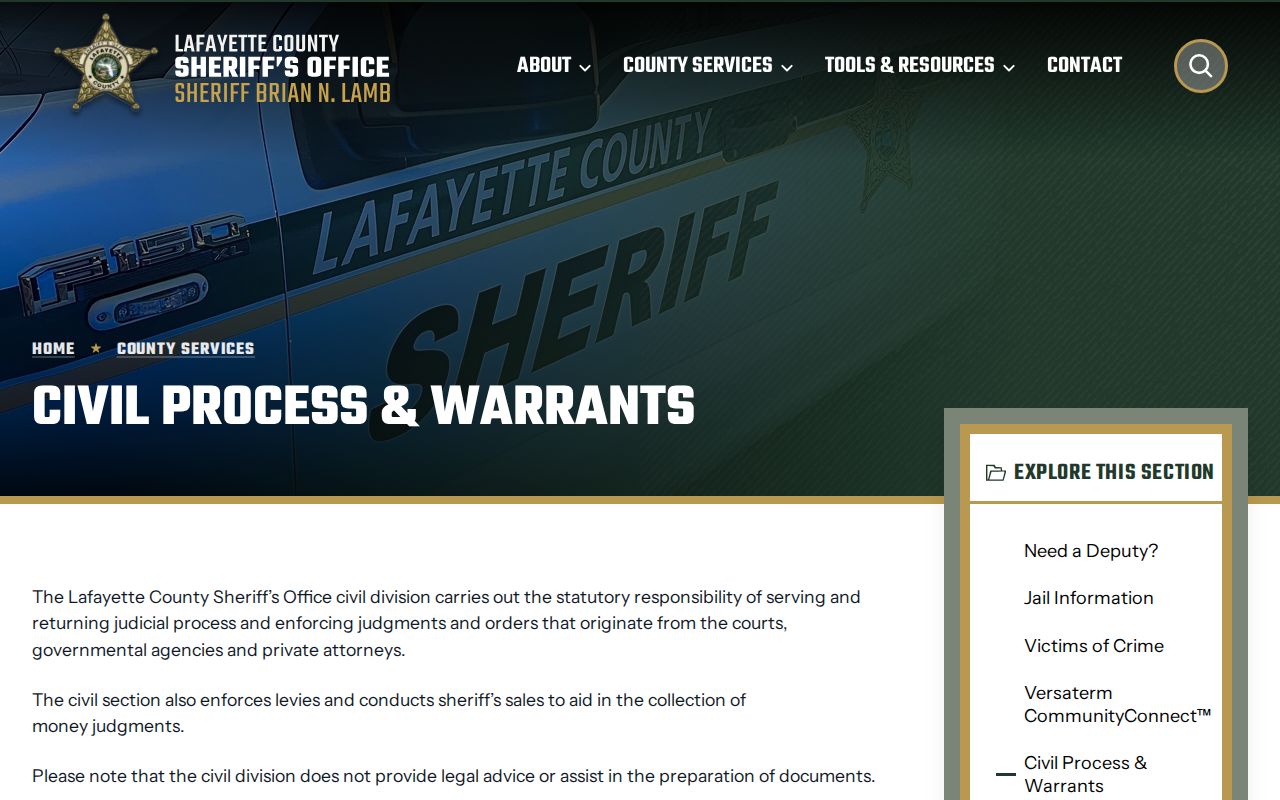
The page confirms the local division and its phone route. It also confirms what is missing: no public warrant search form appears there.
Resolve Lafayette County Warrants Safely
Think a Lafayette County warrant has your name on it? Don't let a search result settle the question. Call a Florida attorney or the right court. A lawyer can confirm the case number. The lawyer can also check the warrant's status and explain the lawful way to respond. The sheriff's office can tell you how to reach the agency, but no web page can weigh your legal options for you.
The Lafayette Clerk's anonymous court search can surface related case events. It stops short of a full active-warrant database, though. Search your name first. Match the case number and filing details, then read the docket in order. If the online records come up thin, phone the Lafayette County Clerk of the Circuit Court and Comptroller at (386) 294-1600. Remember the split in duties. The clerk keeps the court record, while LCSO handles enforcement.
Don't treat the seams between these systems as a chance to stall or dodge process. A safe resolution runs through counsel, the court, and law enforcement together. Avoid showing up at an unconfirmed location. Never act on tips from a secondary site alone.
Lafayette Warrants After an Arrest
Once a warrant turns into a local arrest and booking, the questions shift. Wanted status matters less now. Custody and court status take over. Lafayette County Jail tells you who's held there now. LCSO's records custodian keeps the historical arrest and booking materials, including any booking photograph that's maintained and legally releasable. The county-wide routes are laid out on the Lafayette County busted mugshots home page.
From there, the clerk docket traces the case. What prosecutors file can differ from the booking charges logged at intake. Later entries may show bond hearings, amended counts, dismissal, plea, acquittal, judgment, sentence, or appeal. The disposition is the court's final recorded outcome. It carries far more weight than any stale wanted result or booking photo.
Florida's first-appearance rule covers the early hearing for someone still in custody. It deals with rights, probable cause, counsel, and release conditions. Public pages update at their own pace. Follow the official docket instead. Ask the clerk about anything unclear rather than trusting an old search capture as current.