
Lafayette County Busted Mugshots
Every Lafayette County booking photo starts at the county jail. After an arrest, staff at the Lafayette County Sheriff's Office, which runs the jail, log the person into custody. Then they take the picture most people call a mugshot. That image belongs to an administrative record. It is not the officer's incident report. It is also not the court file that comes later. Mayo adds a wrinkle: the town has no police department or municipal lockup of its own. Anyone arrested there and held locally passes through the same sheriff-run system.
What does the booking record hold? Identity details, the offenses listed at intake, custody information, bond terms, and the photo itself. It captures a single moment early in a case. Charges can change as prosecutors review the matter, and courts can dismiss counts or accept pleas down the line. So the booking photo is just the front door, not the whole house. For what was formally filed and how the case resolved, the Lafayette County Clerk records search is the authoritative source.
Lafayette County Busted Booking Fields
The sheriff's office posts no sample booking card. It posts no online data dictionary either. So spell out exactly which items you want. Do not assume one report holds everything. Florida law lets the agency withhold or redact certain fields. When it does, the custodian should name the exemption being claimed. The custodian should then hand over whatever sits outside that exemption.
| Requested field | What it identifies |
|---|---|
| Booked name and aliases | The identity used at intake and known alternate names |
| Arrest and booking data | Arresting agency, dates, times, location, and booking number |
| Charges as booked | Alleged offense descriptions and statute numbers presented at intake |
| Bond and holds | Bond type or amount and any maintained hold or detainer |
| Court connection | Case number and scheduled first appearance when maintained |
| Custody outcome | Release date, release method, or transfer information |
| Booking photograph | The frontal or profile intake image requested for the named booking |
Two documents get confused often. The arrest affidavit lays out the officer's account of why the arrest happened. The booking sheet simply records the intake itself. Neither one replaces the court docket. Expect different handling for victim information, confidential addresses, active-investigation material, medical details, security data, and any sealed or expunged record.
Request Lafayette County Busted Mugshots
You can reach the Lafayette County Sheriff's Office records team several ways. Phone works, as does the email link on its public-records page. You can also go in person or send mail. No special form is required. The agency posts no booking-photo price and no fixed turnaround time. A narrow request works in your favor. It helps the custodian pull the right arrest. It also cuts the odds of a same-name mix-up pulling the wrong file.
- Give the full booked name, an approximate booking date, and a booking or court number if known.
- Ask separately for the arrest or booking record and the original booking photograph.
- Request electronic delivery when suitable and ask for an estimate before chargeable work begins.
- If part is withheld, ask for the nonexempt remainder and the specific statutory exemption.
- Match the returned record to the clerk case before drawing any conclusion about the outcome.
The official LCSO public-records page lists every access route in one place. It also shows what the county does when a Lafayette County busted mugshot never appears online: you ask directly.
Requests stay useful after release, too. Current custody status and the historical booking file answer different questions, and the public-records channel covers both.
Lafayette County Sheriff's Office231 NW Monroe Avenue
Mayo, FL 32066
Mail: PO Box 227, Mayo, FL 32066
Records: (386) 294-1222
Monday through Friday, 8:00 a.m. to 5:00 p.m.; closed noon to 1:00 p.m.
Lafayette County Mugshot Request Costs
Florida's public-record rules guarantee the right to inspect and copy nonexempt records under reasonable conditions. Section 119.07 sets the default charges for paper copies. It also permits a special service charge when a demand requires extensive technology, clerical, or supervisory work. LCSO publishes no separate fee for booking photos. It promises no set response window either. What counts as prompt depends on the labor a good-faith answer takes.
| Request item | Published rule |
|---|---|
| One-sided paper copy | Up to 15 cents per page for covered standard-size copies |
| Two-sided paper copy | Up to 20 cents per page for covered standard-size copies |
| Certified copy | An added certification charge may apply where authorized |
| Extensive work | A reasonable special service charge based on actual labor or technology may apply |
| Electronic booking photo | No Lafayette-specific price or fixed turnaround is posted |
Two practical tips. Ask for a cost estimate up front. Then set a ceiling you can live with. A request bounded by date and format is far easier to process than a blanket demand for every Lafayette County busted mugshot on file.
Note: A custodian may ask for details needed to locate a record, but a requester generally need not explain the purpose.
Lafayette County Busted Mugshot Law
Florida Constitution article I, section 24 and Chapter 119 open the door to nonexempt public records. Open does not mean posted, though. Lafayette County shows the difference well: the sheriff provides a records route, yet the jail page carries no public roster or photo gallery. So a missing web image proves nothing about exemption or existence. The photo may sit in a file even if no browser can find it.
Florida Statutes section 901.43 targets commercial booking-photo publishers. A person in a photo, or a legal representative, can send a written request by registered mail with enough identifying detail. A publisher covered by the statute must pull the image free of charge within ten calendar days and cannot republish it. The reach is narrow. It governs neither government records nor ordinary news coverage. The official statute page carries the full text of the no-fee process.
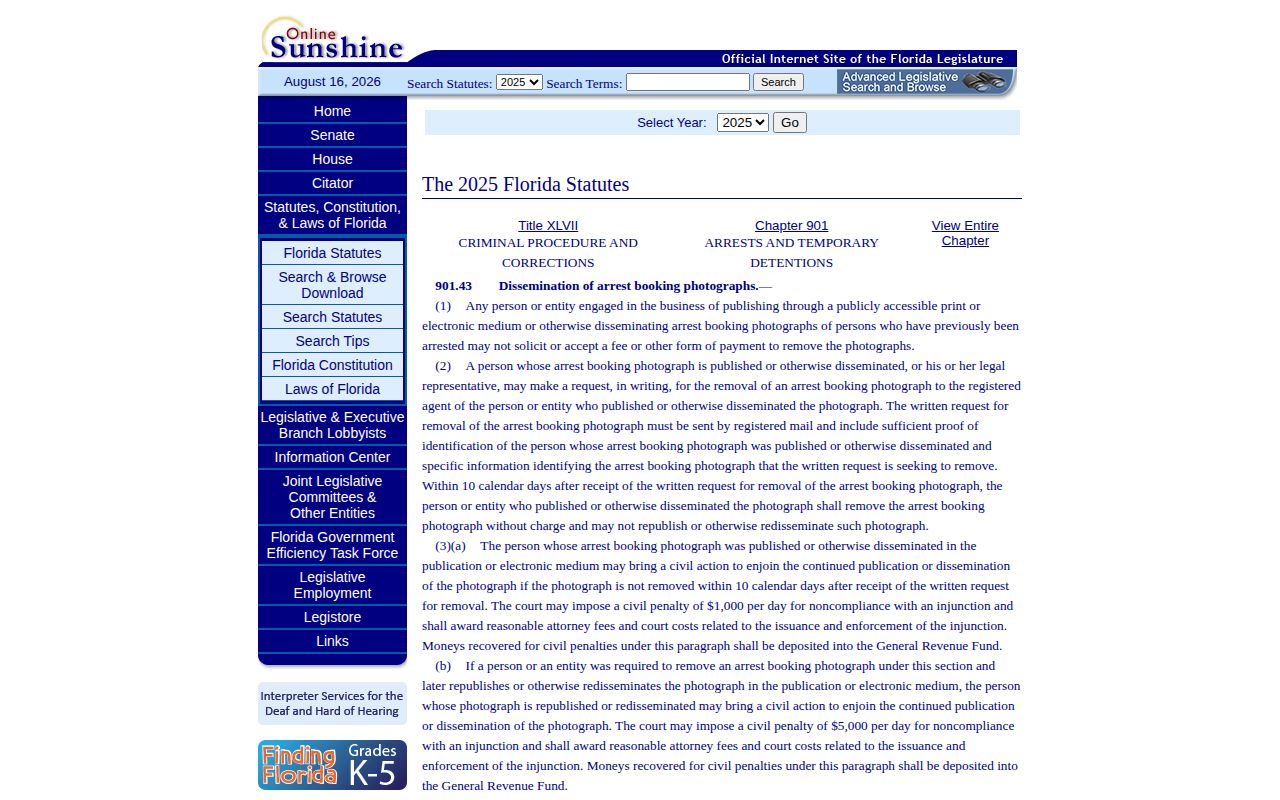
Practical steps matter before any removal effort. Save the exact image address and a dated copy. Identify the publisher's registered agent. Limit the sensitive identity material you share, and keep your postal receipts. Never pay a removal demand before checking the free statutory route.
Some private publishers run free request policies of their own. RecentlyBooked's removal policy covers dismissals, sealing or expunction, inaccurate or outdated details, and mistaken identity, though no Lafayette County section exists. The Mugshots.com contact policy describes no-fee review when you supply supporting documents. These house rules shift without notice. None of them replaces section 901.43, a court order, or a correction at the official source. No verified free process exists for the other major sites tested.
Clearing Lafayette County Busted Images
Getting an image taken down depends on which door you use. Publisher removal, sealing, and expungement are three different processes. Florida sealing or expungement starts with an FDLE Certificate of Eligibility, then a court petition for those who qualify. The certificate alone changes nothing. FDLE reports that its review runs about twelve weeks or longer and cannot be rushed, and the criminal history stays public until a judge grants relief and FDLE receives the certified order.
Who qualifies depends on the case result, prior history, adjudication, and the statutes behind each remedy. No single wait period covers every arrest. A withhold of adjudication does not guarantee eligibility, and special remedies carry their own rules. The Florida Courts sealing and expungement resources carry current forms, while FDLE handles the eligibility process.
One more wrinkle remains. When an official or publisher page finally comes down, the stale search result can be refreshed through the search provider. That refresh does not erase a live source record. A court order, likewise, never deletes copies an outside publisher gathered earlier.
Older Lafayette County Busted Records
Florida's GS2 records schedule sets a floor for booking records and commitment or release lists. The mark is one anniversary year after release, once applicable audits are done. Treat that as a minimum, not a web-display rule or a destruction date. Litigation holds can stretch retention. So can open investigations, a different schedule, or plain local practice. The schedule also fails to clearly place every standalone booking photo under that item.
For an older Lafayette County mugshot, start with LCSO. Ask which schedule controls the photograph they hold. If the record is gone, ask whether it was destroyed under an approved authorization or moved elsewhere. Then check the Lafayette County Clerk for the court file. A state correctional image lives with FDC, not the county jail. The Florida State Archives takes material selectively. It is not a name-indexed statewide mugshot vault.
- Retention
- The minimum period an agency must keep a record under an applicable schedule.
- Disposition
- The final court outcome, not the charge written at booking.
- Expungement
- A court-controlled form of relief with statutory eligibility and access rules.
Find Lafayette County Busted Mugshots
Let the custody stage pick the search path. Lafayette County offers no verified live online roster, booking-photo feed, or archive through the current sheriff site. That gap shapes the first move. Someone reportedly booked today calls for a jail check. A released person's record calls for the records custodian instead. State, federal, and court systems are not substitutes for a county feed.
- Call Lafayette County Jail at (386) 294-4381 for immediate local custody status.
- Request the booking record and photo from LCSO when the person has been released or the image is the main question.
- Use FDLE county-detention data for a dated statewide submission, not a live headcount.
- Open the Lafayette Clerk docket to review filed charges and the later disposition.
- Search FDC only for a person in state corrections or supervision data.
- Use BOP or ICE only when the custody question is federal.
A failed web search proves little. Maybe the person was released, transferred, or cited without local confinement. The name could be entered under a variation, the booking happened elsewhere, or there was no booking at all. Confirm the fact rather than picking a favorite explanation.
Lafayette County Busted Mugshot Channels
Every channel covers a different record. Each covers a different window of time too. Start with official routes. Unofficial sources can lag or hold old entries. Some mix up same-named jurisdictions. Lafayette Parish in Louisiana is a common false match. So are other Lafayette counties.
| Channel | Photo? | Status and best use |
|---|---|---|
| Lafayette County Jail telephone | No web display | Official current local custody check |
| LCSO records request | Request it | Official local booking record or original photo |
| FDLE county-detention dashboard | Not a mugshot source | Official daily statewide booking data complement |
| Lafayette Clerk | Not the booking source | Official case filings and disposition |
| FDC Offender Search | Often | Official state correctional image, not necessarily the local booking photo |
| Lafayette County News | Editorial imagery varies | Unofficial, event-driven regional coverage requiring verification |
| Mugshots.com county page | Yes | Unofficial and apparently stale archival coverage |
RecentlyBooked has published a general no-fee correction and removal policy. No Lafayette County page appears on it, though. Local coverage by Busted Newspaper, Arrests.org, and Mugshots.zone is unconfirmed. Absence today is not absence forever.
Lafayette County Busted Roster Calls
LCSO posts no current-custody roster online. The sheriff's jail page offers facility, mail, and commissary details. But no name-search form. No result cards, no booking photographs. There is no update schedule and no post-release archive. Florida's official county-jail directory also leaves Lafayette's inmate-search entry blank. An old JADES address still lingers in search indexes. It offers no usable current interface, and it should not be treated as official just because a search engine remembers it.
Call Lafayette County Jail and give the full name carefully. Staff may ask for a birth date or another identifier to sort similar names. Ask only for current status they can release. The phone line tells you whether someone is held locally now. It will not hand over the preserved historical booking file. And a release does not erase the booking event.
| Roster element | Lafayette County finding |
|---|---|
| Online search fields | None published on the current official jail site |
| Result-card fields | No official online data dictionary |
| Booking photos | No verified official roster display or web photo policy |
| Update cadence | Not published because no official web roster is available |
| After release | Use LCSO records and the clerk instead of assuming deletion |
Note: No online display does not mean that a nonexempt Lafayette County booking photograph cannot be requested from its custodian.
Lafayette County Busted Booking Feeds
LCSO publishes no verified same-day, 24-hour, or 48-hour booking feed on its site. No separate 72-hour or weekly sheriff blotter surfaces either. Mayo has no municipal police department, so no city bulletin fills the gap. The sheriff exposes no official searchable booking archive. Still, these gaps do not mean the agency lacks internal booking data.
The FDLE Arrest and Booking Reports dashboard is the best official online complement. FDLE refreshes its county-detention presentations daily from contributor submissions through 11:59 p.m. the prior day. A booking date is required. The data generally reaches back to the transparency initiative's 2018 start, unless a contributor supplied older records. The adult scope includes juveniles treated as adults. It is not a live jail roster. It does not promise a booking photo. The interface supports a county and date-based view of Lafayette County booking data.
Want a dated local list? Ask LCSO for the nonexempt jail commitment and release list, or the booking log, for a narrow date range. Request photos only when you truly need them. Images add work and privacy impact.
Lafayette County Arrest Apps Explained
Want a Lafayette County jail app with mugshots? None exists. The sheriff's office does not publish a native inmate-search tool or a booking-photo roster, and installing its website as an app adds nothing new. Its Facebook page carries agency news now and then, but posts there are selective. Anything shared can be edited or pulled without warning.
Versaterm CommunityConnect often gets mistaken for a jail lookup. It isn't one. The service lets residents share household and property details with first responders, and after certain cellular 911 calls it can push one-way updates plus a feedback request. Some counties do fold similar community platforms into custody searches. Lafayette County does not, so treat it as a safety tool rather than an arrest feed.
Lafayette County Custody Alerts
Lafayette County has a few different alert systems, and mixing them up causes confusion. CommunityConnect deals with incident response. Florida VINE covers custody events and requires you to register first. Florida Courts E-Notify sends reminders for participating court dates. None of them stores old booking photos.
For custody notices, the Florida VINE service is the one to use. You can search covered custody records there and sign up for the notice methods it offers. Confirm that the specific record you care about is included. When timing really matters, call the holding agency directly instead of relying on any automated notice. VINE is a convenience, not an emergency plan.
One more thing worth knowing. VINE handles custody searches and registration, not a Lafayette County busted mugshot gallery. That is simply not its purpose.

Court reminders track hearings, while the FDC locator tracks a later correctional stage. Keeping those tools separate prevents a court date from being mistaken for release or current jail status.
Florida Corrections Mugshot Search
The Florida Department of Corrections Offender Search covers people in state correctional populations such as incarcerated, released, supervised, escape, or absconder records. Search by name, then narrow with an FDC number or available identifiers. A matching profile may include an offender photograph, aliases, physical details, location or release status, sentence data, and dates.
An FDC photograph is a state corrections image. It may not be the original Lafayette County Jail booking photo. FDC is also not a recent-arrest feed. It excludes many people who were arrested locally but never entered the state correctional system, remain in pretrial county custody, or are held federally. Population and photo refresh schedules vary by FDC dataset, so those cadences must not be assigned to the county jail.
If the locator does not provide the needed state image, FDC's public-records office is the custodian for its own material. Ask LCSO for the Lafayette jail intake photograph.
Lafayette County Booking Custody Stages
A name can move between systems as the case develops. The correct source depends on what happened after arrest, not on where an old image happens to appear.
| Stage | Best source | What it answers |
|---|---|---|
| Just booked or locally held | Lafayette County Jail telephone | Current local custody, subject to staff release rules |
| Released from local custody | LCSO records request | Historical booking record and requested intake photograph |
| Case filed | Lafayette County Clerk | Docket events, filed charges, hearings, and disposition |
| State sentenced or supervised | FDC Offender Search | State correctional record and possible corrections photo |
| Federal sentence | BOP Inmate Locator | Federal Bureau custody; public results do not show photos |
| Qualifying immigration detention | ICE detainee locator | Covered ICE custody, not a county arrest log |
A person disappearing from a current-custody source does not show why. Release, transfer, or a data change are possibilities, but none should be assumed. It also says nothing about whether prosecutors filed the charge.
Lafayette County First Appearance Records
Florida requires a person arrested without a warrant who remains in custody to receive a first appearance within 24 hours. The judge addresses early issues such as probable cause, counsel, and release conditions. That hearing is not a conviction or final disposition. A news post or unofficial booking copy may not update when the court record changes.
Felonies and juvenile matters go through Circuit Court, while misdemeanors and criminal traffic are handled in County Court. A booking charge can differ from the information later filed by the State Attorney. Docket entries may then show amendment, dismissal, acquittal, plea, sentence, or appeal.
Lafayette Clerk Record Access Levels
The Lafayette Clerk provides anonymous public access as well as registered, party, attorney, and secure subscription access under Florida court rules. Two users may therefore see different document access without the case having vanished. Search by name, compare the case number and filing details, and read the docket in order.
The public view may omit a protected document while still showing the docket event. Contact the clerk's criminal court department at (386) 294-1600 when an online match is unclear. Access level and final case outcome are different questions, so a hidden document should not be treated as a dismissal or erased record.
Lafayette County Juvenile Arrest Limits
Most juvenile court records are confidential, but “juvenile records are never public” is too broad. Florida section 985.04 contains specific confidentiality rules and exceptions. FDLE's county-detention data covers adults and juveniles treated as adults rather than serving as a general youth booking list. Juvenile diversion expungement and automatic retention or expunction rules also depend on the circumstances and age.
Missing or redacted information does not show guilt, innocence, or destruction. A public-record custodian should identify the exemption used, while the clerk controls access to its court records. Do not try to reconstruct a protected identity from news, social posts, or other fragments.
Note: Victim, witness, medical, confidential-address, active-investigation, and security information may also be protected under separate Florida provisions.
Mayo Busted Mugshots
Mayo stands alone in Lafayette County as its only incorporated town. There is no local police force here. No city jail, either. The Sheriff's Office handles everything, from patrols and investigations to dispatch and corrections. That means arrests made inside Mayo follow the same path as those made anywhere else in the county. Booking happens at the Lafayette County Jail. The official records trail runs through the sheriff, the jail, FDLE, and the clerk of court.
The Mayo Busted Mugshots page walks through that trail for town-level arrests. It also flags a common pitfall. Search results sometimes surface places named Mayo in other states, which have nothing to do with Lafayette County. For news coverage, the Lafayette County News crime index is a secondary tool at best. It reaches beyond county lines. So check each story for a Mayo or Lafayette dateline and confirm which agency handled the case.